


Learning module:
Deep time history of Australia
Investigation 2: Two big ideas in deep time history in Australia
Migration to Sahul
The arrival of the first Australians
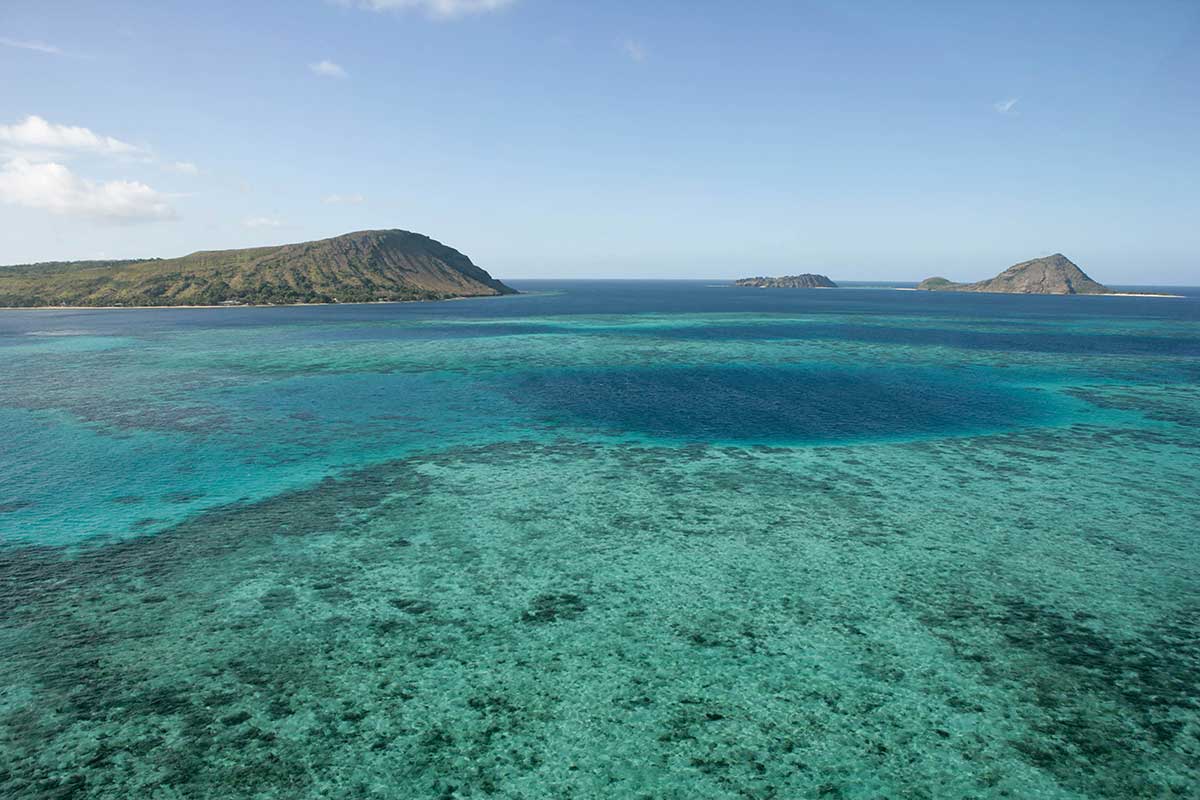
National Museum of Australia
Where did the first Australians come from?
Aboriginal and Torres Strait Islander people believe that humans have always been in Australia. They are part of the Dreaming, the time of creation of all the world.
The content in this resource focuses on scientific and archaeological theories about time and the movement of people across the world and around the Australian continent over tens of thousands of years.
Scientists and archaeologists believe that the first people arrived in Sahul (early Australia) from somewhere else, between 50,000 years ago and 65,000 years ago. Estimates of when people first arrived in Australia change as new evidence is discovered and as scientific techniques of measuring the past are improved.
Before we look at the arrival of early First Nations peoples to what we now know as Australia, let’s think about where modern humans (Homo sapiens) originally came from.
How and where did modern humans develop?
Scientists do not know how or where people (modern humans) developed, but historically, there have been two main scientific theories.
The most commonly held scientific theory is that Homo sapiens developed quite suddenly in Africa sometime in the last few hundred thousand years and then spread around the world, eventually displacing all pre-existing human species, including Homo erectus and Neanderthals.
This might have looked a little like this:
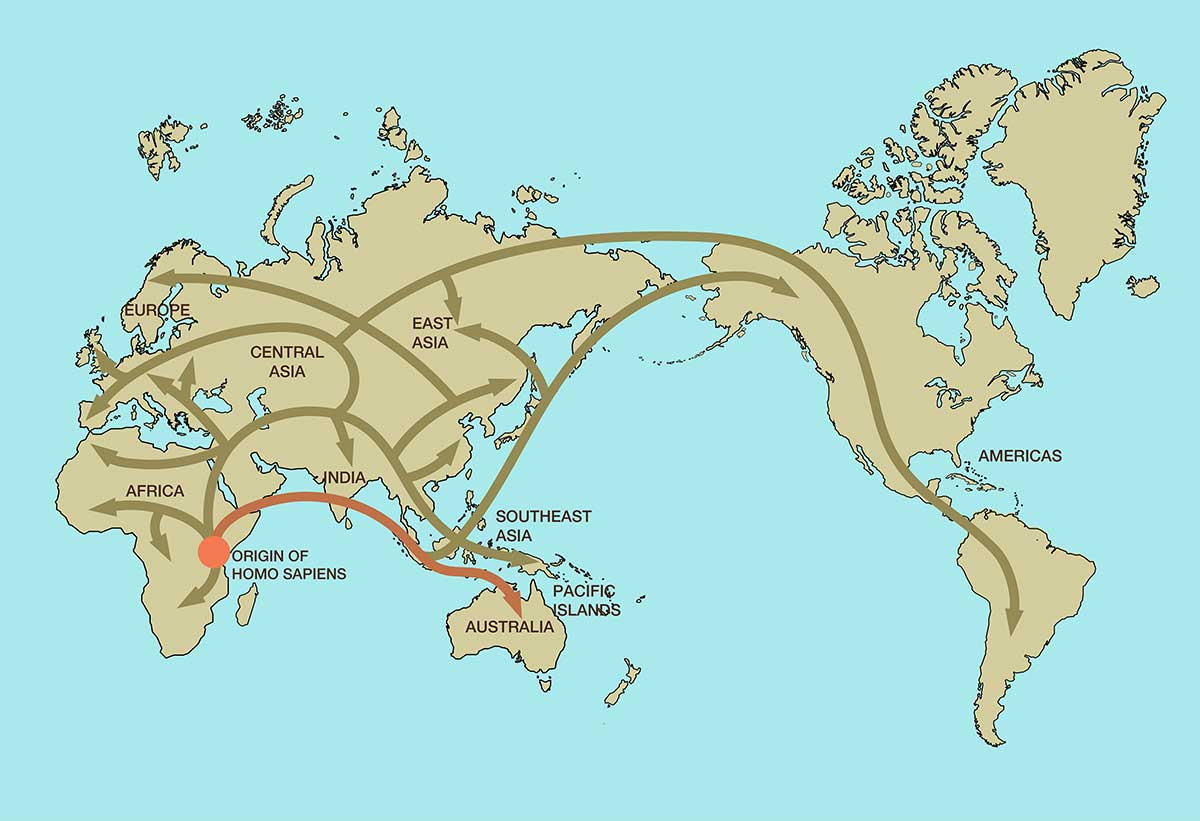
Eliane Touma
The second scientific theory, now mostly rejected, is that when human ancestors first left Africa around 2 million years ago, they spread out into various regional populations. In this model, modern humans – Homo sapiens – then evolved in parallel in these different regions at around the same time.
Current thinking brings together elements of both of these theories. While evidence still points to the theory that all modern humans are descended from a population of Homo sapiens that spread out from Africa sometime in the last few hundred thousand years, the latest findings show that this population also interbred with other human species such as Neanderthals and Denisovans as they spread out, so that although Neanderthals and the more recently discovered Denisovans are now extinct, parts of their genome survive today in Homo sapiens. A genome is a complete set of DNA found in a cell.
What can DNA tell us?
DNA is deoxyribonucleic acid. It is the hereditary material in humans and other life forms. It makes us what we are. We inherit it from our parents. People of different regions have some differences in their DNA, so analysing a person’s DNA can help trace back their family history over many thousands of years.
In 2011, a study was conducted of the DNA found in a West Australian Aboriginal man’s 100-year-old lock of hair (said to have been given to an anthropologist in 1923). It showed no genetic input from modern European Australians and revealed that he was descended from ancestors who migrated from Africa into Asia around 70,000 years ago. The man’s DNA also revealed that his ancestors separated from the ancestors of other human populations 64,000 to 75,000 years ago.
It is thought that changes in climate may have triggered the movement of people from Africa to the Middle East, where conditions were more favourable.
Why did people then travel across to Sahul? Were people in search of a new place to settle – perhaps to escape conflict or population pressures, or just out of a spirit of adventure?
We may never know. Imagine what the people would have felt as they waded ashore onto this new land.
People arrive in Australia
Australia looked very different 65,000 years ago. The continent was larger than it is today. Some land that existed in ancient times is now under the sea. Australia was also joined to other land masses that are now separate islands.
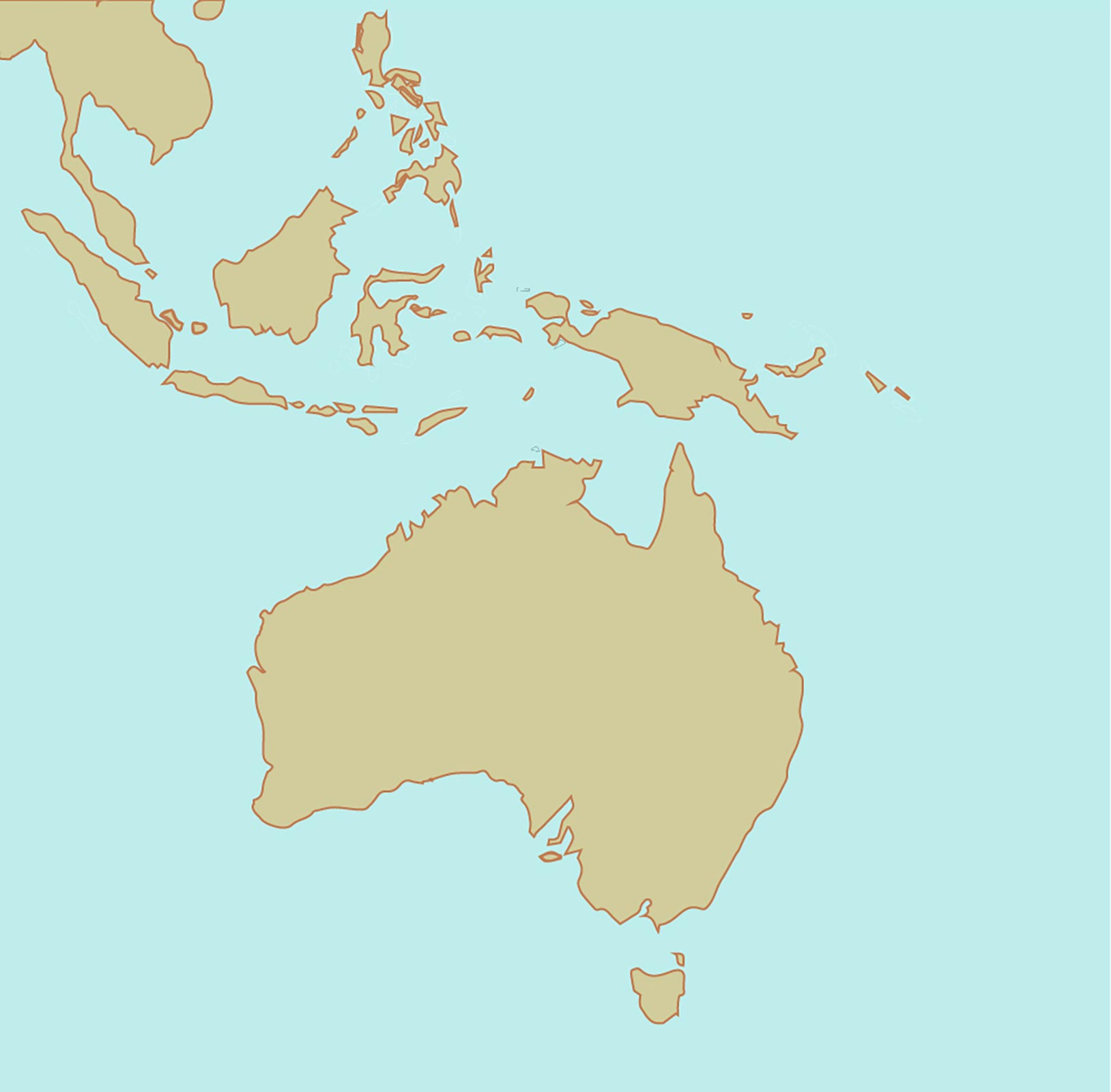
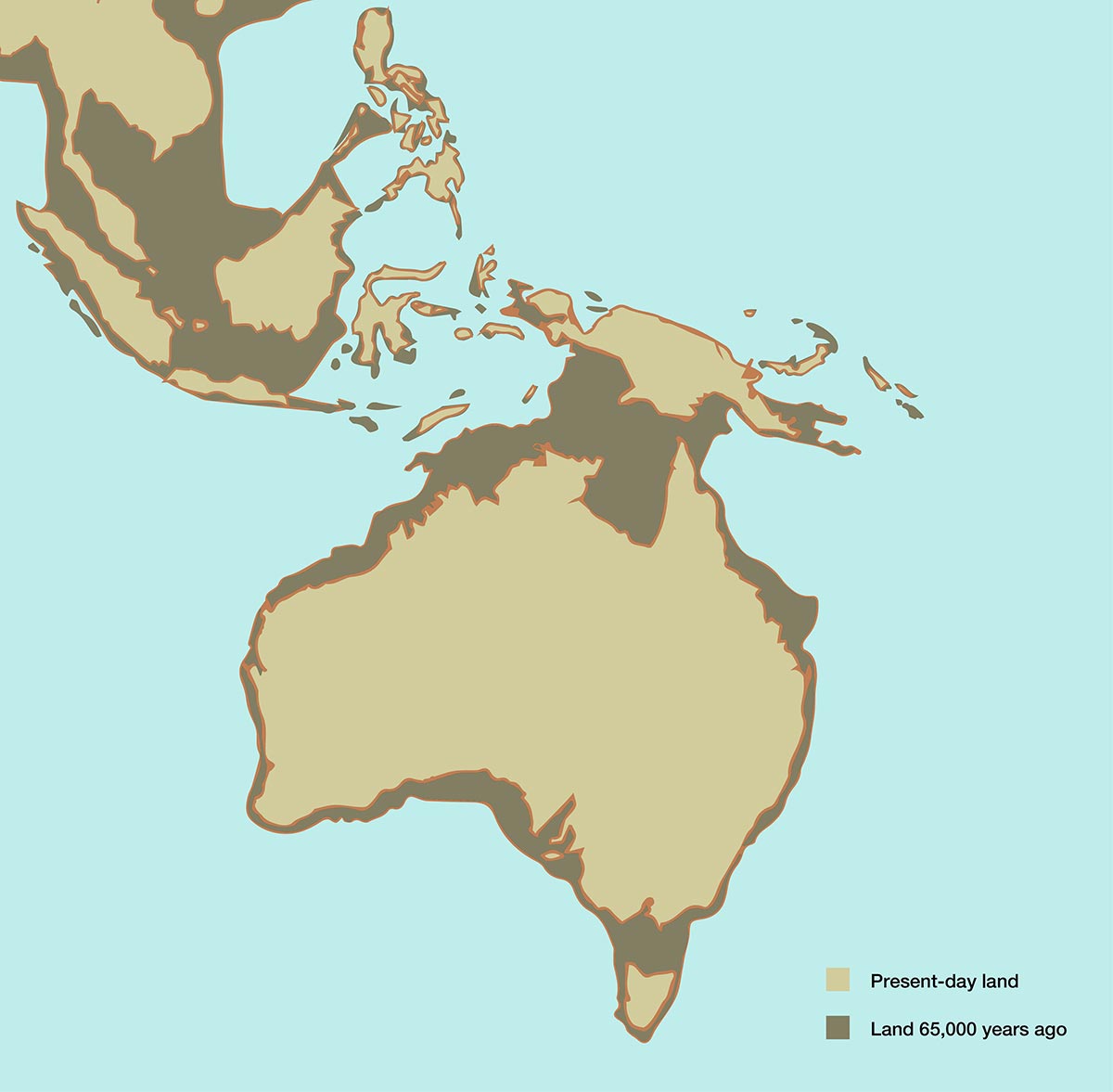
1. Map A shows what Australia looks like now. Map B shows what it looked like about 65,000 years ago. There was much more land as the sea was much lower than it is today. Which two large islands, one in the north and one in the south, were joined to Australia then?
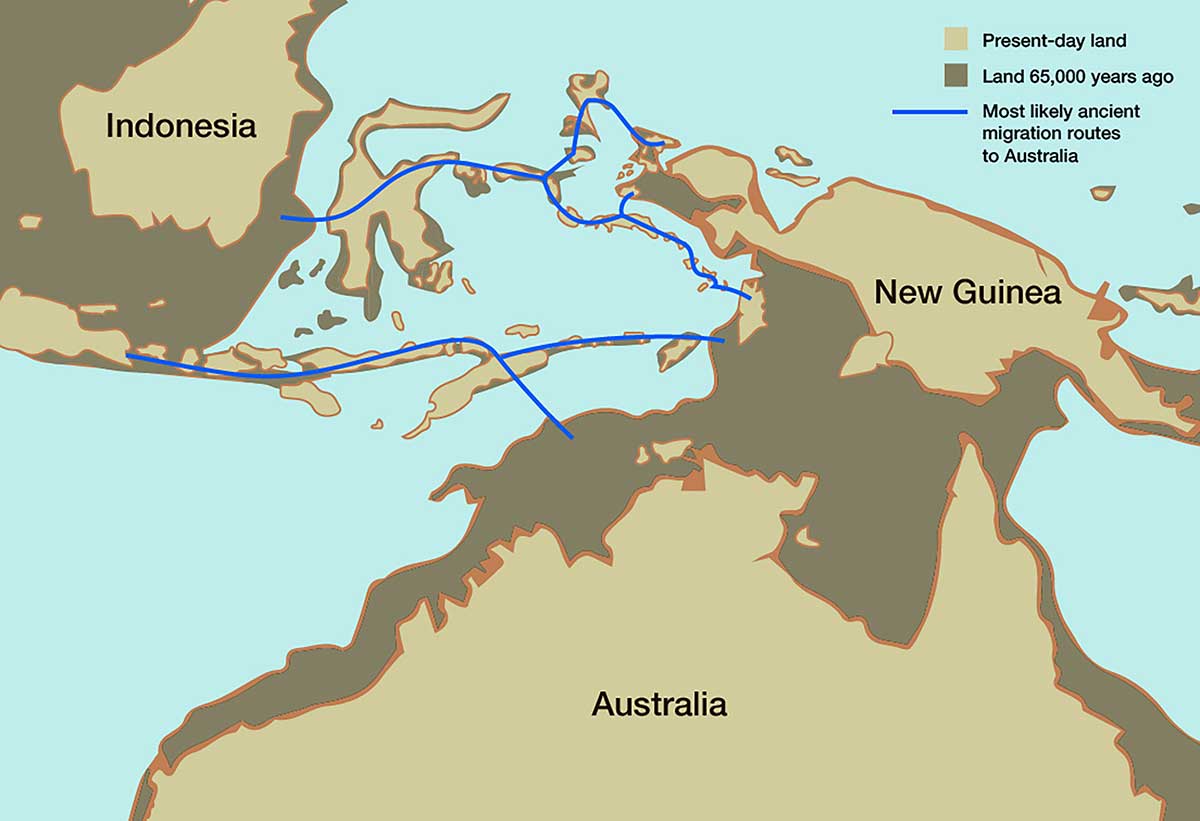
2. Map C shows how First Nations people might have migrated to Australia at this time. This map shows some different possible landing points. Why do you think scientists are not sure where they arrived? [Hint: think about the evidence that would be needed to confirm this and the difficulty of finding this evidence many thousands of years later].
How did people know there was land?
According to scientists, the first people probably came to Australia from the Philippines and Sulawesi, via the area that is now New Guinea, with another minor route to the south. To get to Australia, they may have made a canoe voyage of about 100 or 150 kilometres of open water, which would have been a remarkable maritime achievement. But how did they know that Australia was there?
Imagine that you are about to go on a trip to another place. You cannot see the land — but you know it exists. How might you know that land exists?
3. Complete each of the sentences below to explain how people might have known there was land even though they could not see it. If you need more help, hover over the relevant clue at the bottom.
a) Birds would help you know that there was land because …
b) Smoke would help you know that there was land because …
c) Floating vegetation would help you know that there was land because …
Clue AClue B
Clue C
We know that at this time, some of the land that is now under water off the coast of Australia formed islands. Scientists have worked out how far away each of these hundreds of islands would have been from each other, and whether a person standing on the highest point of each island could have seen another island in the distance. If they could see another island, they could travel there and see the next island. In this way they could in theory have ‘island-hopped’ from Asia to Sahul, paddling or sailing canoes.
How did early First Nations people move around Sahul?
Look at this map. It has been created to illustrate the locations of important archaeological sites as well as the likely routes early First Nations people took when they moved around Sahul.

Map supplied by Professor Corey JA Bradshaw, ARC Centre of Excellence for Australian Biodiversity and Heritage, Global Ecology Lab Partuyarta Ngadluku Wardli Kuu, Flinders University.
To understand how people might move through a new environment, the researchers who created this map used four pieces of information. They considered the topography (the landforms and features), how visible tall landscape features would have been, the locations of freshwater and information about the physical capacity of people. Researchers used these four pieces of information to create a model that generated more than 125 billion possible pathways! By adding information about the oldest archaeological sites in Sahul, the more likely pathways became clearer.
It is believed that some of these extremely old super-highways also correspond to traditional First Nations trading routes, and the European trading and stock routes that followed.
The researchers also found that early First Nations people crossed and lived in all environments in Australia. Their ability to adapt to the ecosystems they found is one of the reasons for the success of the human species!
4. Why do you think it was important for the researchers to consider the topography of Sahul, and the landscape features people would have been able to see, when trying to understand the initial pathways early First Nations people took?
5. In a small group, discuss what you’ve learnt about Sahul and the movements of early First Nations people. Consider:
- where scientists believe people came from
- how people knew where land was
- how Sahul was different from today’s Australia
- what evidence there is for this deep time migration theory
Report your group’s thoughts back to your class.