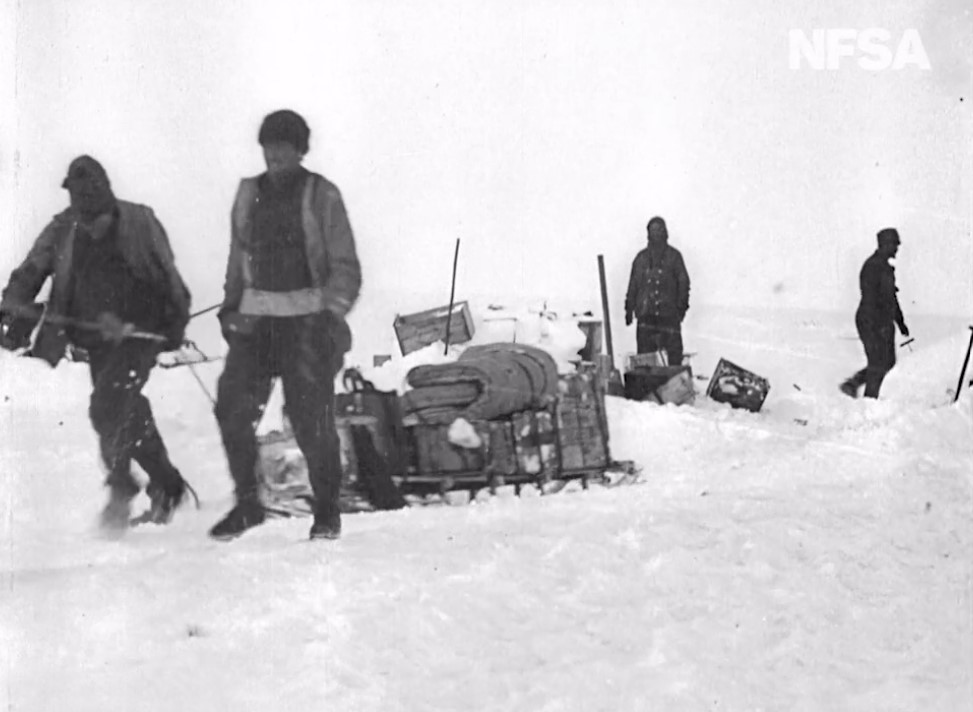



Early Antarctica – The battle for survival
The journey to Antarctica in the early days of exploration was a perilous one. The Southern Ocean was fierce, with violent winds pushing the boats towards the treacherous icy shores.
Louis Bernacchi was the first Australian to work in Antarctica. He accompanied the British Antarctic Expedition (the Southern Cross Expedition) as physicist and astronomer in 1898.
This expedition was the first to spend a winter in Antarctica and the first to undertake scientific research on the continent. Bernacchi’s diary, published in 1901, records the strong impression left by his first sighting of the continent.
Early adventurers who survived the journey to Antarctica found themselves on a continent with nothing to support human life. They had to bring everything they’d need with them – shelter, food and equipment. The items pictured below, from the collection of the Museum, reveal stories of the struggle for survival.
Logistics
The Australasian Antarctic Expedition (AAE) departed Hobart on 2 December 1911. It was led by Australian geologist Douglas Mawson and was comprised of 31 expeditioners.
Their ship, the SY Aurora, carried supplies to support survival. This included food, medical equipment, sledging gear, materials to build huts, and wireless masts and transceivers to establish radio communications.
It also carried a group of sled dogs, though in Antarctica much of the transport of gear and supplies across the ice fell to the men themselves. Harnesses attached the men to laden sleds they dragged behind them.
The harness placed a heavy strain on the upper body but was designed for easy removal should the unlucky manhauler or his loaded sledge fall into a crevasse. Releasing himself from the sledge and supplies would give him a chance to survive. Each man took the maintenance of his harness seriously – his life depended on it.


Activity 1: Curate a story
How can objects tell the stories of places or experiences? These artefacts from the AAE allow us to vividly imagine what it might have been like to battle against extreme weather conditions while undertaking a range of physical challenges, such as pulling a laden sledge.
Choose three objects that represent a story or experience from your life. Your objects could tell the story of a cherished memory, of overcoming a challenge, or of an activity or cause you care about. How will you order your objects and how will the information you include in your exhibition help to tell your story?
Expedition dangers
The dangers faced by the expeditioners of the AAE were never far from their minds.
John Henry Collinson Close was an assistant collector for the AAE. While in Antarctica, he wrote regular letters to his wife, Alice, despite knowing these letters would not be posted until he returned to Hobart.
In a letter written in November 1912, Close bids Alice farewell, in a very matter-of-fact way, in case he does not return from an upcoming sledging trip.
‘We are all extremely busy at present and are about to leave on the summer sledging trips for which the camp is in a turmoil of preparation. I do not anticipate any fatality but it is best to be prepared. So I write you to bid you my loving farewell in case of my not returning. If when the ship comes for us in January the sledge parties (5 in number) are not all back a wait will be made for a time but if after a couple of weeks from due date of return any are not back at the hut it is safe to assume that some fatal accident has occurred, for provisions will have been exhausted and only death can then ensue in the interior of a land which is nothing but ice, snow, and bitter cold, and which has absolutely no resources whatever inland in the way of food. (Parties have to be sent out sledging with provisions covering a certain number of days and with but small margin for delays). In such case it would be but cruel to bid you hope for my safety.’
Close returned safely to Australia and Alice in 1913. However, not all AAE members were so fortunate.
Death of Ninnis and Mertz
In November 1912 a sledging party led by Mawson departed the base the AAE had established at Commonwealth Bay. They intended to explore the coast to the east, on what was anticipated to be a two-month trek.
Belgrave Ninnis and Xavier Mertz accompanied Mawson. The night before their departure, Ninnis wrote in his diary, ‘We and the Southern party leave tomorrow. I must close my writing now, maybe for two months, maybe for good and all, for who knows what might happen during the next two months.’
Tragically, Ninnis and Mertz both perished on this venture. Ninnis, his dogs and a sledge laden with critical supplies – including almost all the party’s food as well as their tent – plunged into a crevasse on 14 December 1912.
Mertz died a month later, most likely poisoned from eating dog livers, which the remaining two men were forced to consume due to the loss of most of the food.
Return of Mawson
Mawson struggled on alone for 30 days to return to Commonwealth Bay, knowing the ship, the SY Aurora, would soon be leaving, to avoid being trapped by the winter sea ice.
Devastatingly, having finally reached the relative safety of base camp, Mawson learnt the SY Aurora had departed, unable to wait any longer.
Six of Mawson’s men, however, had stayed on at Commonwealth Bay, having volunteered to continue the search for their leader and his long overdue sledging party. They were condemned to waiting out a second year on the ice, far from home.
A plaque commemorating the deaths of Belgrave Ninnis and Xavier Mertz was carved from the timber of the dining table in the main hut of the AAE’s winter quarters at Cape Denison. In the photograph, Interior of the Commonwealth Bay living hut, Mertz sits on the far left, next to the table that would become his memorial.


Activity 2: Historical concepts – contestability
Look at the ‘heroic’ imagery in the slideshow below and compare these to the ‘gritty’ reality presented in the letters and diaries of expedition members. What does your comparison tell you? Why do you think there are ‘gaps’ in the visual narrative, where the suffering of the men was omitted?
Write a comparative analysis of the historical record and make an argument for why you believe this ‘gap’ exists between the two groups of historical primary sources.


Activity 3: Research and communication
Investigate the motivations for the AAE within the context of the newly-federated Australian nation. Imagine you are Mawson pitching the expedition to the Australian Government in 1910. Create a persuasive speech or poster using evidence from the time.
Details
+ --
Year level: